
ARTICLE
Reconsidering Shame: Calibration and Narrowing
Shame shapes how we move with the people who matter, and understanding its function changes how we live with it.
By Thomas Workman, PhD
Licensed Professional Counselor
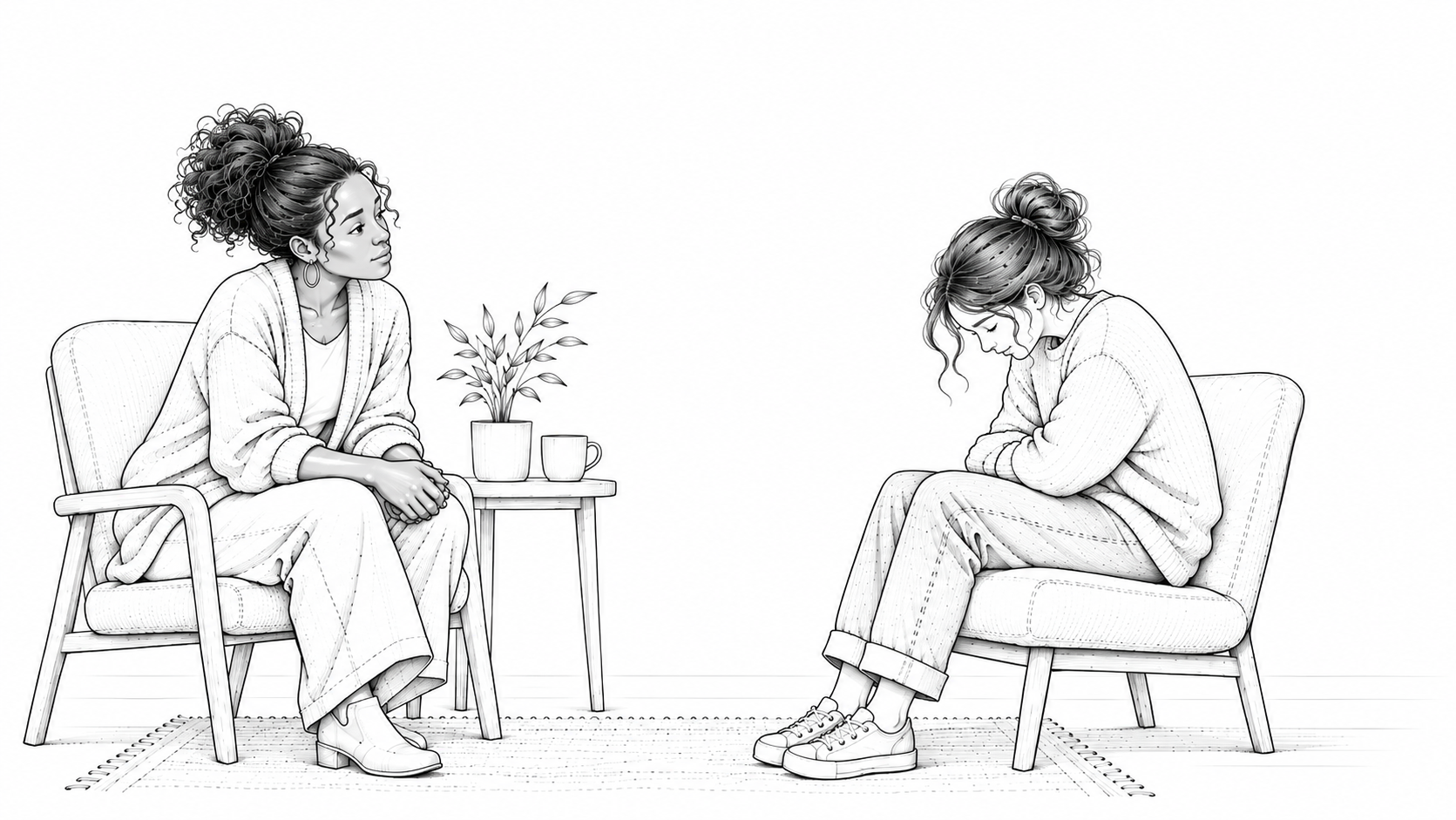
Someone you care about says something that stings, and you start to answer. The reply forms quickly, but something catches it before it reaches the other person. Maybe halfway through the sentence, maybe while you’re still working out what to say. Your face warms, your voice hitches, your eyes go to theirs, and then the sentence comes out softer or slower than it started. You still chose your words, but you didn’t choose them alone. Shame was calibrating your response to someone who matters.
That night, you find yourself repeatedly reviewing it in your head. You wonder whether you were too sharp, or whether you gave in too easily, and whether you should have said something else entirely. You think about texting them to make sure things are okay. At some level, you may even know that the exchange went fine, but you keep questioning yourself anyway.
The first moment is shame, the root emotion, functioning. The second contributes to where shame gets its reputation. In everyday life, and within the mental health field, we have narrowly come to know shame through its most painful expressions: humiliation, rejection, inadequacy, the sense that something is fundamentally wrong with us. As a clinician, I work with people who have carried shame for decades, often without realizing how much it continues to shape their lives. What we go through can leave shame overactive, quick to arise where nothing calls for it and attached to things we did nothing to cause. That suffering is real, and it deserves serious clinical attention.
But we don’t judge other emotions by only their worst forms. We can recognize that fear serves a purpose even though it can become a debilitating phobia. Anger has value even though it can become destructive. Research on basic emotions places shame alongside fear and anger among the strongest candidates for a basic emotion (Cordaro, 2024). Shame deserves the same consideration, including a close look at what it does when it is functioning, and how much of what we call by other names is shame itself.
What We Mean by Shame
In everyday speech, we use the word shame to describe feeling inadequate, exposed, or less worthy in the eyes of others. That describes one way shame can show up, not the emotion itself. Shame is a basic emotion with a single root, which initiates a network of responses in the body that organizes us when our standing with another person or group is at stake. The evidence suggests that guilt, embarrassment, and vulnerability are not isolated, separate emotions. They are that same root, showing up in different contexts, coupled with different representations, and shaped by different histories. When our attention is on what we did to someone, we call it guilt. When we make a slip in public, we call it embarrassment. When we choose to be seen in order to be close, we call it vulnerability.
This is not a new idea. The affect theorist Silvan Tomkins (1963) treated shame, guilt, shyness, and embarrassment as one affect that feels different depending on what accompanies it: guilt is shame joined with a sense of having done wrong, and shyness is shame in the presence of a stranger. Basic emotion research is consistent with this. Cordaro’s (2024) list of its strongest candidates includes shame but not guilt or embarrassment. Where research has treated them as distinct, it has largely done so at the level of how they are labeled and expressed, not at the core of the response. Much of that work rests on self-report, which depends on the emotion words a language makes available and captures only part of what a person experiences (Scherer, 2009). Even researchers who argue for the distinction note that the same events, such as lying, cheating, or stealing, lead some people to report shame and others to report guilt, and that many people, clinicians included, use the two words interchangeably (Tangney et al., 2007).
Underneath the labels, they start in the same place. What we usually call shame, the painful, self-focused form, and what we call guilt both begin with the sense of being responsible. They diverge in how the person represents what happened: as something stable about the self and beyond their control, or as a specific act that can change (Tracy & Robins, 2006). Which representation comes most readily reflects what a person has learned. Brain imaging shows the same structure. The states we label shame, guilt, and embarrassment share a core of activity tied to emotional awareness and arousal, and they diverge in the areas that interpret the situation and shape what we do next (Piretti et al., 2023). The evidence points to a single root taking different forms, which is why research on embarrassment and guilt tells us something about shame, and why this article draws on all three.
When a coworker’s face falls after a joke at their expense, the next joke doesn’t come. Shame has organized our response without our choosing it, a defining feature of emotion that researchers call unbidden occurrence (Cordaro, 2024). We don’t decide whether the feeling arises, but what we do with it stays ours.
How Shame Calibrates
Human survival has always depended on other people. Food, protection, and the care of children ran through cooperation and the bonds that held groups together. Evolutionary accounts treat emotions as adaptations that organize us around the kinds of situations our ancestors faced again and again (Tooby & Cosmides, 1990/2024). A capacity that registered changes in our relationships and adjusted behavior to match carried a real advantage. Shame is one of those capacities.
The evidence crosses cultures. Sznycer and colleagues (2018) studied anticipated shame among 899 people in 15 small-scale communities with different languages, cultures, and ways of life. How much shame people anticipated closely tracked how negatively others in the same communities judged the situation described. Shame is calibrated to what the people around us actually care about.
That calibration does more than protect our standing; it regulates our relationships. To feel shame at all, we have to hold in mind how another person sees us, which is the same perspective-taking that empathy depends on. A change in a friend’s tone draws our attention to them. When we realize we’ve hurt someone, the same root shows up as guilt and moves us to approach and repair.
In the moment, shame organizes what we notice, how we read the encounter, and which actions feel available. It helps us calibrate when to speak, when to hold back, and when another person’s needs deserve our attention. The reply that softened in the opening was exactly this. We rely on it to take part in relationships, make decisions in front of others, and protect the people and commitments closest to us.
The discomfort is part of how it works. When something we’ve done threatens an important relationship or standard, the unease interrupts what we’re doing and presses us to reconsider it. Empathy and reasoning can also change behavior, but an unpleasant feeling gives certain moments an urgency that detached reflection does not.
Toward People, Not Only Away
Once shame begins organizing our response, what happens next depends on the circumstances. When repair seems possible, shame moves people to restore a threatened sense of self; when repair looks too difficult or risky, they protect themselves by pulling back (de Hooge et al., 2010). In two experiments, people made to feel shame preferred a task done with someone else over one done alone (de Hooge et al., 2018). That runs against the stereotypical picture, but it makes sense: much of how we see ourselves comes from belonging, so when shame threatens that view, moving toward people is one way to restore it. The familiar urge to seek reassurance after feeling ashamed is the same pull, and as we’ll see, it can harden into a habit. Withdrawal is one of shame’s responses, not its definition.
Shame is strongest with the people we most want to be close to, in the form we call vulnerability: asking for help, telling someone they hurt us, admitting to a partner that we’ve been struggling. We choose to open up, and still we hesitate, the words catch, and eye contact gets hard to hold. We slow down and watch for how we’re being received, even when closeness is exactly what we want. The relationships that make us most sensitive to rejection are the same ones in which we risk the most to get closer.
That sensitivity is not a sign the closeness is failing. The other person can see it, and it tells them something. Research on the visible indicators of shame supports this. Reviewing the evidence on shame and embarrassment displays, Keltner and Buswell (1997) concluded that they appease the people who see them: shame elicits sympathy, which leads others to offer forgiveness and help, and embarrassment prompts forgiveness and restores the flow of an interaction. Feinberg and colleagues (2012) found that people who visibly showed embarrassment, the lighter, public form of shame, were seen as more prosocial, and observers were more willing to trust and affiliate with them.
Even the blush does this work. People who blushed after a transgression or a mishap were judged more favorably than those who did not (Dijk et al., 2009). In a trust game, a partner who blushed after acting selfishly was handed more money than one who didn’t and was expected to be less likely to do it again (Dijk et al., 2011). The flush and the dropped eyes are part of how someone knows the moment matters to us.
When Shame Narrows
The same sensitivity that draws people closer can also leave us stuck in a pattern. Imagine making an awkward comment at a social gathering. A brief silence follows and shame rises. A neutral face now looks disapproving, discomfort grows, and you start finding more signs of rejection. The emotion shapes the reading, the reading feeds the emotion, and saying anything else feels too risky.
Every emotion organizes our response, and sometimes that organization narrows so far that other readings and courses of action become hard to reach. In Emotion Reflex Therapy, we call that loss of access. It is not a matter of intensity. Someone can feel strong shame and still act effectively, while a quieter response that leads to avoidance or self-condemnation every time can be far more restrictive. The question is how much room remains while the emotion is active.
Getting stuck usually has a history. Trauma, chronic criticism, or growing up where mistakes were met with contempt teaches a person to expect judgment and to read their own missteps as proof of something stable about them and beyond their control. That reading turns shame toward its painful, self-focused form, and each time the person withdraws or takes an encounter as evidence of inadequacy, the pattern strengthens. While the root of shame is evolutionarily inherited, a pattern like this is learned.
Some histories can evoke shame even when no wrongdoing has occurred. A person who was humiliated for expressing needs may feel ashamed while setting a reasonable boundary. They say no, and the heat arrives anyway, along with the urge to take it back or explain it away. Nothing in the situation calls for an apology. Feeling shame tells us something has become emotionally consequential; it does not establish that we’ve behaved badly.
In a meta-analysis of 108 studies, Kim and colleagues (2011) found a strong association between shame and depressive symptoms, and the associations for two maladaptive forms of guilt were statistically indistinguishable from shame’s, which is consistent with a single root. The name we give an emotion does not tell us how much it is restricting someone’s life. What matters is how the response is interpreted, repeated, and connected to behavior.
Feeling Shame Without Losing Access
Mindfulness lets us see shame organizing the moment while it is happening: the situation that set it off, the sensations and readings that follow, and the behaviors we reach for to get relief. Checking whether the feeling has passed, or analyzing what it says about us, is the same second-guessing that filled the evening after the softened reply. It pulls attention away from what is actually in front of us.
The person setting a boundary is caught in the same loop. Their usual move is to apologize, explain at length, or ask whether the other person is upset, and because reassurance has eased the discomfort often enough, seeking it has become a habit. But the boundary was reasonable, and seeing the familiar sequence lets them feel the shame and hold the boundary anyway. Had they said something cruel, acknowledgment and repair would be the right response. We might call the first shame and the second guilt, but it is the same root either way, and the feeling does not decide which response is warranted.
This is where understanding the functional nature of shame matters. A defect can only be fought, but a capacity that works for us can be allowed to stay long enough to ask whether it fits what is actually happening. That allowing is acceptance, and research on mindfulness-based approaches points to it, not attention alone, as a key ingredient (Lindsay & Creswell, 2019).
Practicing a different response while the feeling is still active, such as holding the boundary without asking for reassurance, lets a person find out what happens when they don’t follow the old habit, and allows for new pathways to form. The root is inherited; the pattern was learned, and what was learned can be revised (May, 2011). That revision happens between people too: being seen and accepted where shame expects rejection is part of what changes it, and part of what good therapy offers. Progress often shows up first in what we do while shame is present, before the feeling itself fades. We don’t have to wait until shame disappears to begin changing our lives.
References
Cordaro, D. (2024). Basic emotion theory: A beginner’s guide. In L. Al-Shawaf & T. K. Shackelford (Eds.), The Oxford handbook of evolution and the emotions (pp. 3–20). Oxford University Press. https://doi.org/10.1093/oxfordhb/9780197544754.013.1
de Hooge, I. E., Zeelenberg, M., & Breugelmans, S. M. (2010). Restore and protect motivations following shame. Cognition and Emotion, 24(1), 111–127. https://doi.org/10.1080/02699930802584466
de Hooge, I. E., Breugelmans, S. M., Wagemans, F. M. A., & Zeelenberg, M. (2018). The social side of shame: Approach versus withdrawal. Cognition and Emotion, 32(8), 1671–1677. https://doi.org/10.1080/02699931.2017.1422696
Dijk, C., de Jong, P. J., & Peters, M. L. (2009). The remedial value of blushing in the context of transgressions and mishaps. Emotion, 9(2), 287–291. https://doi.org/10.1037/a0015081
Dijk, C., Koenig, B., Ketelaar, T., & de Jong, P. J. (2011). Saved by the blush: Being trusted despite defecting. Emotion, 11(2), 313–319. https://doi.org/10.1037/a0022774
Feinberg, M., Willer, R., & Keltner, D. (2012). Flustered and faithful: Embarrassment as a signal of prosociality. Journal of Personality and Social Psychology, 102(1), 81–97. https://doi.org/10.1037/a0025403
Keltner, D., & Buswell, B. N. (1997). Embarrassment: Its distinct form and appeasement functions. Psychological Bulletin, 122(3), 250–270. https://doi.org/10.1037/0033-2909.122.3.250
Kim, S., Thibodeau, R., & Jorgensen, R. S. (2011). Shame, guilt, and depressive symptoms: A meta-analytic review. Psychological Bulletin, 137(1), 68–96. https://doi.org/10.1037/a0021466
Lindsay, E. K., & Creswell, J. D. (2019). Mindfulness, acceptance, and emotion regulation: Perspectives from Monitor and Acceptance Theory (MAT). Current Opinion in Psychology, 28, 120–125. https://doi.org/10.1016/j.copsyc.2018.12.004
May, A. (2011). Experience-dependent structural plasticity in the adult human brain. Trends in Cognitive Sciences, 15(10), 475–482. https://doi.org/10.1016/j.tics.2011.08.002
Piretti, L., Pappaianni, E., Garbin, C., Rumiati, R. I., Job, R., & Grecucci, A. (2023). The neural signatures of shame, embarrassment, and guilt: A voxel-based meta-analysis on functional neuroimaging studies. Brain Sciences, 13(4), Article 559. https://doi.org/10.3390/brainsci13040559
Scherer, K. R. (2009). Emotions are emergent processes: They require a dynamic computational architecture. Philosophical Transactions of the Royal Society B: Biological Sciences, 364(1535), 3459–3474. https://doi.org/10.1098/rstb.2009.0141
Sznycer, D., Xygalatas, D., Agey, E., Alami, S., An, X.-F., Ananyeva, K. I., Atkinson, Q. D., Broitman, B. R., Conte, T. J., Flores, C., Fukushima, S., Hitokoto, H., Kharitonov, A. N., Onyishi, C. N., Onyishi, I. E., Romero, P. P., Schrock, J. M., Snodgrass, J. J., Sugiyama, L. S., … Tooby, J. (2018). Cross-cultural invariances in the architecture of shame. Proceedings of the National Academy of Sciences, 115(39), 9702–9707. https://doi.org/10.1073/pnas.1805016115
Tangney, J. P., Stuewig, J., & Mashek, D. J. (2007). Moral emotions and moral behavior. Annual Review of Psychology, 58, 345–372. https://doi.org/10.1146/annurev.psych.56.091103.070145
Tomkins, S. S. (1963). Affect, imagery, consciousness: Vol. 2. The negative affects. Springer Publishing Company.
Tooby, J., & Cosmides, L. (2024). The past explains the present: Emotional adaptations and the structure of ancestral environments. In L. Al-Shawaf & T. K. Shackelford (Eds.), The Oxford handbook of evolution and the emotions (pp. 21–54). Oxford University Press. https://doi.org/10.1093/oxfordhb/9780197544754.013.2 (Original work published 1990)
Tracy, J. L., & Robins, R. W. (2006). Appraisal antecedents of shame and guilt: Support for a theoretical model. Personality and Social Psychology Bulletin, 32(10), 1339–1351. https://doi.org/10.1177/0146167206290212